A Brief History of Bluegrass Music
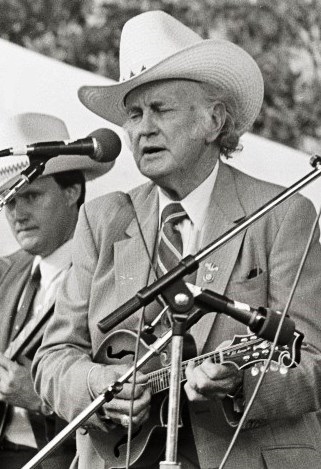
William Smith “Bill” Monroe
The roots of bluegrass music can be traced to the people who came to America in the 1600s from Ireland, Scotland, England, Europe, and Africa, bringing traditional dance tunes and ballads from their homelands. As the settlers began to move into North and South Carolina, Tennessee, Kentucky, Virginia, West Virginia, and other parts of the American South, they wrote songs about daily life in the new land. Since many of these people lived in remote areas, their songs reflected life on the farm or in the hills. This music was often referred to as hillbilly or old-time music. Its development included the blending of elements from gospel music, the blues, early jazz, and various forms of commercial music. The proliferation of phonograph and radio technology in the early 20th century brought this music out of the hills and into the homes of people all over the United States.
There were gourd-bodied lutes with long and short strings in Africa, but the five-string banjo played in bluegrass music emerged in the Americas through the adaptation of African musical traditions by enslaved people of African descent. Early banjos were made from gourds, calabashes, and wood, with skin heads, and often had three long strings and one short string. The banjo became a central part of African American spiritual, ritual, and communal life, carried across the Atlantic and throughout the Americas, evolving into the five-string style we recognize today. Interesting histories can also be told about the other instruments used in bluegrass music: the fiddle (same as a violin), the steel-string guitar, the mandolin, the plucked string bass, and the resonator guitar (also known as a “Dobro,” with Hawaiian and Slovak ancestry).

Bill Monroe’s Uncle Pen Vandiver
Bill Monroe, a native of Rosine, Kentucky born on September 13, 1911, is generally considered the “Father of Bluegrass Music.” Bill grew up working and playing music with his siblings on the family farm adjacent to Jerusalem Ridge. His musical foundation was shaped by the singing, banjo, and fiddle playing of his mother, Malissa (Vandiver) Monroe; the fiddling of his uncle Pendleton (Pen) Vandiver; and the fiddling and guitar playing of his friend Arnold Shultz, a popular Black musician who played extensively around western Kentucky, and on riverboats headed to New Orleans.
Shultz (1886-1931) was the son of a former slave who developed a style on the guitar that fans said sounded as full as a piano. His playing impressed both white and Black musicians, including some who achieved national fame. Shultz had an impact on Monroe’s approach to music, and was the person who hired Bill for his first paying gigs as a guitarist backing Shultz’s fiddle at community dances. Arnold Shultz was inducted in the Bluegrass Hall of Fame in 2025.
The youngest of eight children, Bill Monroe went to live with his Uncle Pen Vandiver at age 11, after both his parents died. Pen, a talented fiddler who encouraged Bill’s interest in music, performed with his nephew often. (Listen to Bill’s song, “Uncle Pen,” for more of that story).
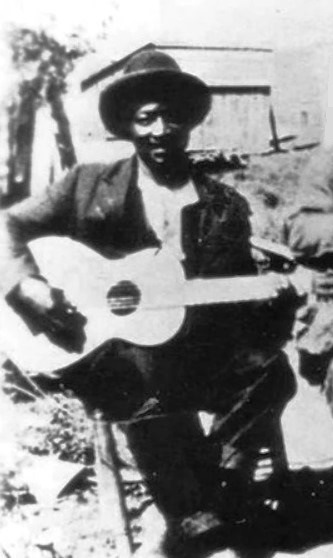
Arnold Shultz, early musical influence on Bill Monroe
Bill Monroe and his brother Charlie left Kentucky as young adults to move to Chicago to work and eventually they formed a group known as the Monroe Brothers. They started out dancing professionally, and then focused on their musical duo, one of the most popular acts of the 1930s. Charlie played guitar, Bill played mandolin, and they sang in harmony. When the brothers split in 1938, both went on to form their own bands. Bill eventually adopted the name “Bill Monroe and his Blue Grass Boys” for his band. This band started a new form of country music. The Blue Grass Boys were named after Bill’s home state of Kentucky, which is the Bluegrass State.
Monroe and his band first appeared on the Grand Ole Opry stage in 1939 and soon became one of the most popular touring acts to emerge from Nashville’s WSM studios. The Blue Grass Boys were different from other country bands because of their hard-driving and powerful sound that used acoustic instruments and featured distinctively high vocal harmonies. Bill’s music incorporated songs and rhythms from string bands, gospel (Black and white), work songs, country music, and blues repertoires. Vocal selections included duet, trio, and quartet harmony singing in addition to Bill’s powerful, “high lonesome” lead singing. After experimenting with various instrumental combinations, Bill settled on mandolin, banjo, fiddle, guitar, and bass for the core of his band.
While some bluegrass fans date the genre to 1939 when Monroe first appeared on the Grand Ole Opry, others believe that the classic bluegrass sound came together in December, 1945, when Earl Scruggs joined the band. Scruggs, a 21-year-old from North Carolina, played an innovative three-finger picking style on the banjo (which came to be known as “Scruggs style”) with such drive and clarity that it energized and excited audiences. Also influential in the classic 1945 line-up of the Blue Grass Boys were Lester Flatt (of Sparta, Tennessee) on guitar and lead vocals; Chubby Wise from Florida on fiddle; and Floridian Howard K. Watts—also known by his comedian name “Cedric Rainwater”—on the upright bass.
In 1947 two brothers from the mountains of southwestern Virginia formed a second group that played in the exciting, but yet-unnamed style pioneered by Monroe’s band. Carter Stanley—guitarist, lead singer, and prolific songwriter—appeared with his brother Ralph—on banjo and singing tenor—as the Stanley Brothers. Recording on Columbia, Rich-R-Tone, Mercury, Starday, and King Records, the brothers employed other influential musicians and contributed a catalog of songs and instrumental tunes that are widely played to this day.
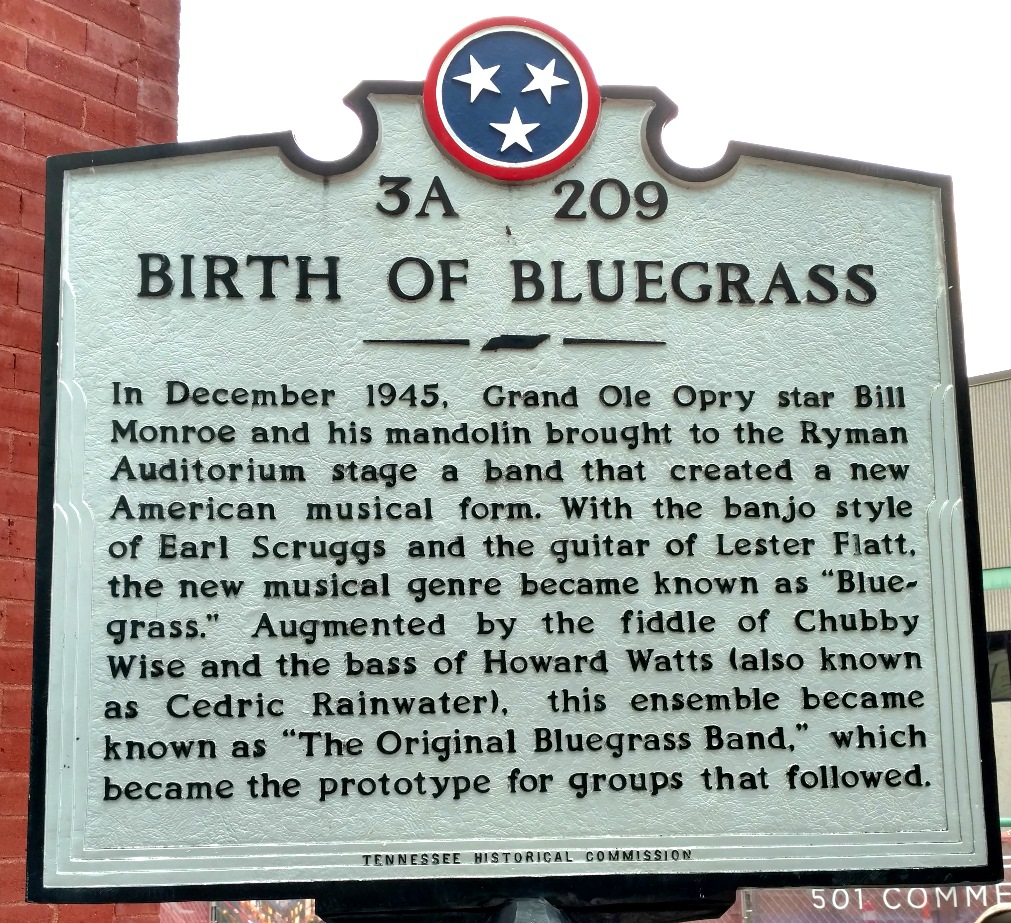
Birth of Bluegrass sign by the Tennessee Historical Commission at the Ryman Auditorium
In 1948 Earl Scruggs and Lester Flatt departed Monroe and formed their own group, The Foggy Mountain Boys. In 1950, wishing to differential their sound from Monroe’s, they added the resophonic guitar, or “Dobro,” into their band. Burkett H. “Uncle Josh” Graves, from Tellico Plains, Tennessee, heard Scruggs’ three-finger style of banjo picking in 1949 and adapted it to the then almost obscure slide bar instrument. As a member of the Foggy Mountain Boys from 1955-1969, Graves introduced his widely emulated, driving, bluesy style. The resophonic guitar is often included in the bluegrass band format today as a result.
From 1948 through 1969, the Flatt and Scruggs band was a major force in introducing bluegrass music to America through national television, radio, and appearances at schoolhouses, coliseums, and major universities around the country. Scruggs wrote and recorded one of bluegrass music’s most famous instrumentals, “Foggy Mountain Breakdown,” which was used in the soundtrack for the film Bonnie & Clyde. In 1969 he established an innovative solo career with his sons as the Earl Scruggs Revue. Scruggs continued to record and perform in groups that usually included his sons Randy (on guitar) and Gary (on bass) until his death in 2012. After parting with Scruggs in 1969, Lester Flatt continued successfully with his own group, the Nashville Grass, performing until shortly before his death in 1979.
By the late 1950s, there were numerous other bands playing in the style. Notable among them were Jim and Jesse and the Virginia Boys, Mac Wiseman, Reno and Smiley and the Tennessee Cut-Ups, Jimmy Martin and the Sunny Mountain Boys, the Osborne Brothers, and the Country Gentlemen. The common sound needed a name, and people began referring to it as “bluegrass music.” Bluegrass bands began forming all over the country and Bill Monroe became the acknowledged “Father of Bluegrass Music,” a title coined in 1963 by Monroe’s agent, Ralph Rinzler, in an article for Sing Out! magazine.”

Bill Monroe’s restored childhood home on Jerusalem Ridge in Rosine, Kentucky
In the 1960s, the concept of the “bluegrass festival” was first introduced, featuring bands on the same bill that had previously been viewed as competitors for a relatively limited audience. Bluegrass Hall of Famer Carlton Haney, from Reidsville, North Carolina, is credited with envisioning and producing the first multi-day (weekend) bluegrass music festival, held in Fincastle, Virginia in 1965.
The wide availability of traditional music through broadcasting and recording technology; bluegrass festivals and associations proliferating throughout the United States; movie, television, and commercial soundtracks featuring bluegrass music; and a growing international bluegrass presence have helped to bring the music to mainstream audiences. Lester Flatt, Earl Scruggs, and the Foggy Mountain Boys achieved national prominence with tour sponsorship by Martha White Flour and for playing the soundtrack for the film Bonnie and Clyde (1964), as well as the theme song (and appearances on) the Beverly Hillbillies television show (1962-1971).
The soundtrack to the movie Deliverance also featured bluegrass music, specifically “Dueling Banjos,” performed by Eric Weissberg on banjo and Steve Mandell on guitar. The Nitty Gritty Dirt Band’s Will the Circle Be Unbroken triple LP set, re-released in 1972, introduced artists like Earl Scruggs, Doc Watson, Jimmy Martin, Maybelle Carter, Roy Acuff, and others to pop music fans and brought the authentic sounds of bluegrass and traditional country music to new audiences. In 2001, the triple-platinum soundtrack for the Coen Brothers movie, O Brother, Where Art Thou?, helped to attract even wider audiences to bluegrass and old-time music. Comedian Steve Martin’s love and performance of five-string banjo music and internationally famous artists Alison Krauss and Billy Strings are more recent factors in the popularity of bluegrass.
Bill Monroe passed away on September 9, 1996, four days before his 85th birthday. In May 1997, he was inducted into the Rock and Roll Hall of Fame because of the profound influence of his style on popular music. He is also a member of the Country Music Hall of Fame (1970) and the Bluegrass Music Hall of Fame (1991).
In addition to the classic style born in the mid-20th century that is still performed widely, bluegrass bands today reflect influences from a variety of sources including the blues, traditional and fusion jazz, contemporary country music, Celtic music, rock and roll (“newgrass,” progressive, or “jamgrass,”), old-time music, Southern gospel music, and international music. The International Bluegrass Music Association claims members in all 50 states and 30 countries. Popular bluegrass bands are now fronted by talented female musicians like Alison Krauss, Rhonda Vincent, Sierra Hull, and Molly Tuttle. The Kentucky-born music with international roots in the U.K., Europe, and Africa is now performed and enjoyed by musicians and fans around the world.
~~~~~~~~~~~~~~~~~~~~~~~~~~~~
This history results from the work, passion, kindness, and courtesy of several authors, including Greg Cahill, Nancy Cardwell (the International Bluegrass Music Association and the IBMA Foundation), the Bluegrass Music Hall of Fame and Museum, Alan W. Tompkins, Kristina Gaddy, Fred Bartenstein, and Erika Brady, Ph. D.
More information about the history of bluegrass music can be obtained at Wikipedia.com and from a number of excellent resources, including:
Books:
Adler, Thomas A. Bean Blossom: The Brown County Jamboree and Bill Monroe’s Bluegrass Festivals, Univ. of Illinois Press, 2011.
Bartenstein, Fred (editor). Josh Graves, Bluegrass Bluesman: A Memoir, Univ. of Illinois Press. 2012.
Bartenstein, Fred and Ellison, Curtis (editors). Industrial Strength Bluegrass: Southwestern Ohio’s Musical Legacy, Univ. of Illinois Press. 2021.
Cantwell, Robert S. Bluegrass Breakdown: The Making of the Old Southern Sound, Univ. of Illinois Press, 1984. Da Capo Press, 1992.
Castelnero, Gordon. Russell, David L. Earl Scruggs: Banjo Icon, Rowman & Littlefield, 2017.
Ewing, Tom. Bill Monroe: The Life and Music of the Blue Grass Man, Univ. of Illinois Press, 2018.
Harris, Craig. Bluegrass, Newgrass, Old-Time, and Americana Music, Pelican Publishing, 2018.
Henry, Murphy. Pretty Good for a Girl: Women in Bluegrass, Univ. of Illinois Press, 2013.
Rosenberg, Neil V. Bluegrass: A History, 20th Anniversary Ed., Univ. of Illinois Press, 2005.
Smith, Richard. Can’t You Hear Me Callin’, The Life of Bill Monroe, Father of Bluegrass, Da Capo Press, 2001.
Stafford, Tim and Wright, Caroline. Still Inside: The Tony Rice Story, World of Mouth Press, 2010.
Stanley, Ralph. Dean, Eddie. Man of Constant Sorrow: My Life and Times, Gotham Books, 2009.
Wolfe, Charles K. The Devil’s Box: Masters of Southern Fiddling, Vanderbilt Univ. Press, 1997.
Wright, John. Traveling the High Way Home: Ralph Stanley and the World of Traditional Bluegrass Music, Univ. of Illinois Press, 1995.
Magazines:
Bluegrass Unlimited
Bluegrass Today
Bluegrass Now (out of print, edited by Wayne Bledsoe)
Muleskinner News (out of print, edited by Fred Bartenstein)
Moonshiner (Japan, bomserv.com)
Pickin’ (out of print, edited by Don Kissil)
The Bluegrass Situation
The Bluegrass Standard
The Cornerstone, the e-newsletter of the IBMA Foundation